 Add to Chrome
 Add to Firefox
 Add to Edge
Surface Constraint Policy for Learning Surface-Constrained and Dynamically Feasible Robot Skills
May 29, 2026
Diffusion-based imitation learning methods have driven rapid progress in robot dexterous manipulation tasks. However, they have limitations when applied to tasks that involve complex free-form surface constraints because of their lack of explicit surface geometry constraint modeling and the dynamic feasibility issue, resulting in stochastic action generation that fails to achieve reliable surface alignment and maintain stable contact. To address these limitations, we propose a novel surface constraint policy (SCP) for generating robot actions that satisfy free-form surface constraints on the basis of human demonstrations and real-time visual observations. First, the surface geometry constraint is encoded using a two-dimensional weighted Gaussian kernel function that is derived from demonstrations. Building on the encoded surface geometry constraints, the diffusion-based policy is used to infer task-level action intentions from multimodal sensory inputs, including visual observations and robot state feedback. These intentions are further transformed into surface-constrained dynamic movement primitives (DMPs) through a similarity-based action mapping method, thereby enabling smooth and compliant motion execution. The SCP achieves generation of structured surface geometric intent and dynamically admissible actions. The proposed method is validated on multiple surface manipulation tasks and compared with existing techniques. The experimental results demonstrate superior task success rates and contact stability under surface constraints.

Ask Now, Use Later: Benchmarking the Proactivity Gap in Long-Lived LLM Agents
May 28, 2026A long-lived LLM agent, such as OpenClaw, earns its value by acting on a user's preferences and constraints across sessions, not just the current request. Yet today's agents keep what a user volunteers but rarely ask for what stays unspoken, leaving a proactivity gap in long-lived LLM agents: an agent cannot act on a preference it never obtained. As users delegate more of their affairs to agents, the impact of this gap grows. We isolate one concrete, controllable slice of this gap as Ask-to-Remember (ATR): the agent decides whether to ask now for a reusable user preference that the current task does not need but a later session with the same user will. ATR is hard even to evaluate: the right question is underdetermined and its payoff deferred to tasks that may never arise. ATRBench, to the best of our knowledge the first ATR benchmark, makes it measurable by fixing each user's preferences as hidden ground truth, so success demands asking, not recall. Across eight frontier LLM agents, defaults fall at least 62 points below an oracle handed the relevant preference, and prompting closes little of it. Diagnostics identify acquisition as the bottleneck. ATRBench surfaces this proactivity gap in current agents and offers a diagnostic testbed for closing it.
Optimal Uncertainty-Aware Calibration for the AX=YB Problem
May 06, 2026This article proposes a general optimization framework for solving hand-eye calibration problem. Unlike traditional methods, an iterative algorithm based on Lie algebra that achieves approximately global optimal solutions is developed. During the optimization process, the method strictly preserves the structural constraints of the calibration parameters and enables synchronized updates between calibration parameters. Recognizing that data used in real-word hand-eye calibration often contain uncertainty, especially in over-loading and large workspace industrial robot scenarios, which can significantly degrade accuracy, and accurately modeling such uncertainty is inherently difficult, this article avoids explicit uncertainty modeling. Instead, an uncertainty metric to evaluate the relative uncertainty between data sources is introduced and used to dynamically refine the iterative process. To further enhance convergence efficiency, an effective initial solution generation method that improves overall stability and accuracy is designed. Numerical simulations and real-world experiments validate the effectiveness of the proposed approach, and in synthetic datasets, the proposed approach improves the estimation accuracy by at least 67\% under high-uncertainty conditions compared with the existing methods.
Chatting about Conditional Trajectory Prediction
Apr 20, 2026Human behavior has the nature of mutual dependencies, which requires human-robot interactive systems to predict surrounding agents trajectories by modeling complex social interactions, avoiding collisions and executing safe path planning. While there exist many trajectory prediction methods, most of them do not incorporate the own motion of the ego agent and only model interactions based on static information. We are inspired by the humans theory of mind during trajectory selection and propose a Cross time domain intention-interactive method for conditional Trajectory prediction(CiT). Our proposed CiT conducts joint analysis of behavior intentions over time, and achieves information complementarity and integration across different time domains. The intention in its own time domain can be corrected by the social interaction information from the other time domain to obtain a more precise intention representation. In addition, CiT is designed to closely integrate with robotic motion planning and control modules, capable of generating a set of optional trajectory prediction results for all surrounding agents based on potential motions of the ego agent. Extensive experiments demonstrate that the proposed CiT significantly outperforms the existing methods, achieving state-of-the-art performance in the benchmarks.
Chatting about Upper-Body Expressive Human Pose and Shape Estimation
Apr 20, 2026Expressive Human Pose and Shape Estimation (EHPS) plays a crucial role in various AR/VR applications and has witnessed significant progress in recent years. However, current state-of-the-art methods still struggle with accurate parameter estimation for facial and hand regions and exhibit limited generalization to wild images. To address these challenges, we present CoEvoer, a novel one-stage synergistic cross-dependency transformer framework tailored for upper-body EHPS. CoEvoer enables explicit feature-level interaction across different body parts, allowing for mutual enhancement through contextual information exchange. Specifically, larger and more easily estimated regions such as the torso provide global semantics and positional priors to guide the estimation of finer, more complex regions like the face and hands. Conversely, the localized details captured in facial and hand regions help refine and calibrate adjacent body parts. To the best of our knowledge, CoEvoer is the first framework designed specifically for upper-body EHPS, with the goal of capturing the strong coupling and semantic dependencies among the face, hands, and torso through joint parameter regression. Extensive experiments demonstrate that CoEvoer achieves state-of-the-art performance on upper-body benchmarks and exhibits strong generalization capability even on unseen wild images.
A Self-Evolving Agentic Framework for Metasurface Inverse Design
Apr 01, 2026Metasurface inverse design has become central to realizing complex optical functionality, yet translating target responses into executable, solver-compatible workflows still demands specialized expertise in computational electromagnetics and solver-specific software engineering. Recent large language models (LLMs) offer a complementary route to reducing this workflow-construction burden, but existing language-driven systems remain largely session-bounded and do not preserve reusable workflow knowledge across inverse-design tasks. We present an agentic framework for metasurface inverse design that addresses this limitation through context-level skill evolution. The framework couples a coding agent, evolving skill artifacts, and a deterministic evaluator grounded in physical simulation so that solver-specific strategies can be iteratively refined across tasks without modifying model weights or the underlying physics solver. We evaluate the framework on a benchmark spanning multiple metasurface inverse-design task types, with separate training-aligned and held-out task families. Evolved skills raise in-distribution task success from 38% to 74%, increase criteria pass fraction from 0.510 to 0.870, and reduce average attempts from 4.10 to 2.30. On held-out task families, binary success changes only marginally, but improvements in best margin together with shifts in error composition and agent behavior indicate partial transfer of workflow knowledge. These results suggest that the main value of skill evolution lies in accumulating reusable solver-specific expertise around reliable computational engines, thereby offering a practical path toward more autonomous and accessible metasurface inverse-design workflows.
Anatomical Prior-Driven Framework for Autonomous Robotic Cardiac Ultrasound Standard View Acquisition
Mar 22, 2026Cardiac ultrasound diagnosis is critical for cardiovascular disease assessment, but acquiring standard views remains highly operator-dependent. Existing medical segmentation models often yield anatomically inconsistent results in images with poor textural differentiation between distinct feature classes, while autonomous probe adjustment methods either rely on simplistic heuristic rules or black-box learning. To address these issues, our study proposed an anatomical prior (AP)-driven framework integrating cardiac structure segmentation and autonomous probe adjustment for standard view acquisition. A YOLO-based multi-class segmentation model augmented by a spatial-relation graph (SRG) module is designed to embed AP into the feature pyramid. Quantifiable anatomical features of standard views are extracted. Their priors are fitted to Gaussian distributions to construct probabilistic APs. The probe adjustment process of robotic ultrasound scanning is formalized as a reinforcement learning (RL) problem, with the RL state built from real-time anatomical features and the reward reflecting the AP matching. Experiments validate the efficacy of the framework. The SRG-YOLOv11s improves mAP50 by 11.3% and mIoU by 6.8% on the Special Case dataset, while the RL agent achieves a 92.5% success rate in simulation and 86.7% in phantom experiments.
PTalker: Personalized Speech-Driven 3D Talking Head Animation via Style Disentanglement and Modality Alignment
Dec 27, 2025Speech-driven 3D talking head generation aims to produce lifelike facial animations precisely synchronized with speech. While considerable progress has been made in achieving high lip-synchronization accuracy, existing methods largely overlook the intricate nuances of individual speaking styles, which limits personalization and realism. In this work, we present a novel framework for personalized 3D talking head animation, namely "PTalker". This framework preserves speaking style through style disentanglement from audio and facial motion sequences and enhances lip-synchronization accuracy through a three-level alignment mechanism between audio and mesh modalities. Specifically, to effectively disentangle style and content, we design disentanglement constraints that encode driven audio and motion sequences into distinct style and content spaces to enhance speaking style representation. To improve lip-synchronization accuracy, we adopt a modality alignment mechanism incorporating three aspects: spatial alignment using Graph Attention Networks to capture vertex connectivity in the 3D mesh structure, temporal alignment using cross-attention to capture and synchronize temporal dependencies, and feature alignment by top-k bidirectional contrastive losses and KL divergence constraints to ensure consistency between speech and mesh modalities. Extensive qualitative and quantitative experiments on public datasets demonstrate that PTalker effectively generates realistic, stylized 3D talking heads that accurately match identity-specific speaking styles, outperforming state-of-the-art methods. The source code and supplementary videos are available at: PTalker.
Foundation Model-based Evaluation of Neuropsychiatric Disorders: A Lifespan-Inclusive, Multi-Modal, and Multi-Lingual Study
Dec 24, 2025Neuropsychiatric disorders, such as Alzheimer's disease (AD), depression, and autism spectrum disorder (ASD), are characterized by linguistic and acoustic abnormalities, offering potential biomarkers for early detection. Despite the promise of multi-modal approaches, challenges like multi-lingual generalization and the absence of a unified evaluation framework persist. To address these gaps, we propose FEND (Foundation model-based Evaluation of Neuropsychiatric Disorders), a comprehensive multi-modal framework integrating speech and text modalities for detecting AD, depression, and ASD across the lifespan. Leveraging 13 multi-lingual datasets spanning English, Chinese, Greek, French, and Dutch, we systematically evaluate multi-modal fusion performance. Our results show that multi-modal fusion excels in AD and depression detection but underperforms in ASD due to dataset heterogeneity. We also identify modality imbalance as a prevalent issue, where multi-modal fusion fails to surpass the best mono-modal models. Cross-corpus experiments reveal robust performance in task- and language-consistent scenarios but noticeable degradation in multi-lingual and task-heterogeneous settings. By providing extensive benchmarks and a detailed analysis of performance-influencing factors, FEND advances the field of automated, lifespan-inclusive, and multi-lingual neuropsychiatric disorder assessment. We encourage researchers to adopt the FEND framework for fair comparisons and reproducible research.
Robotic Grinding Skills Learning Based on Geodesic Length Dynamic Motion Primitives
Apr 24, 2025
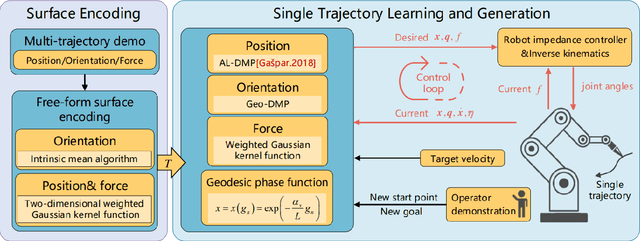
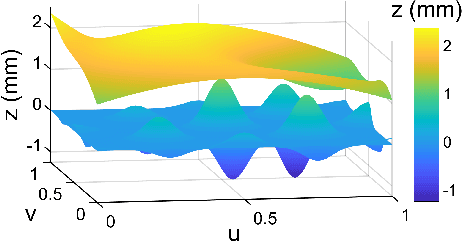
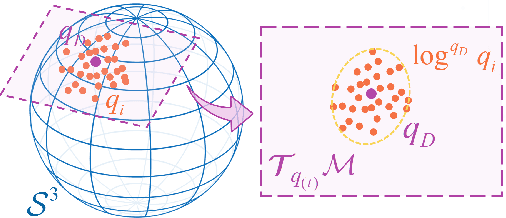
Learning grinding skills from human craftsmen via imitation learning has become a key research topic in robotic machining. Due to their strong generalization and robustness to external disturbances, Dynamical Movement Primitives (DMPs) offer a promising approach for robotic grinding skill learning. However, directly applying DMPs to grinding tasks faces challenges, such as low orientation accuracy, unsynchronized position-orientation-force, and limited generalization for surface trajectories. To address these issues, this paper proposes a robotic grinding skill learning method based on geodesic length DMPs (Geo-DMPs). First, a normalized 2D weighted Gaussian kernel and intrinsic mean clustering algorithm are developed to extract geometric features from multiple demonstrations. Then, an orientation manifold distance metric removes the time dependency in traditional orientation DMPs, enabling accurate orientation learning via Geo-DMPs. A synchronization encoding framework is further proposed to jointly model position, orientation, and force using a geodesic length-based phase function. This framework enables robotic grinding actions to be generated between any two surface points. Experiments on robotic chamfer grinding and free-form surface grinding validate that the proposed method achieves high geometric accuracy and generalization in skill encoding and generation. To our knowledge, this is the first attempt to use DMPs for jointly learning and generating grinding skills in position, orientation, and force on model-free surfaces, offering a novel path for robotic grinding.